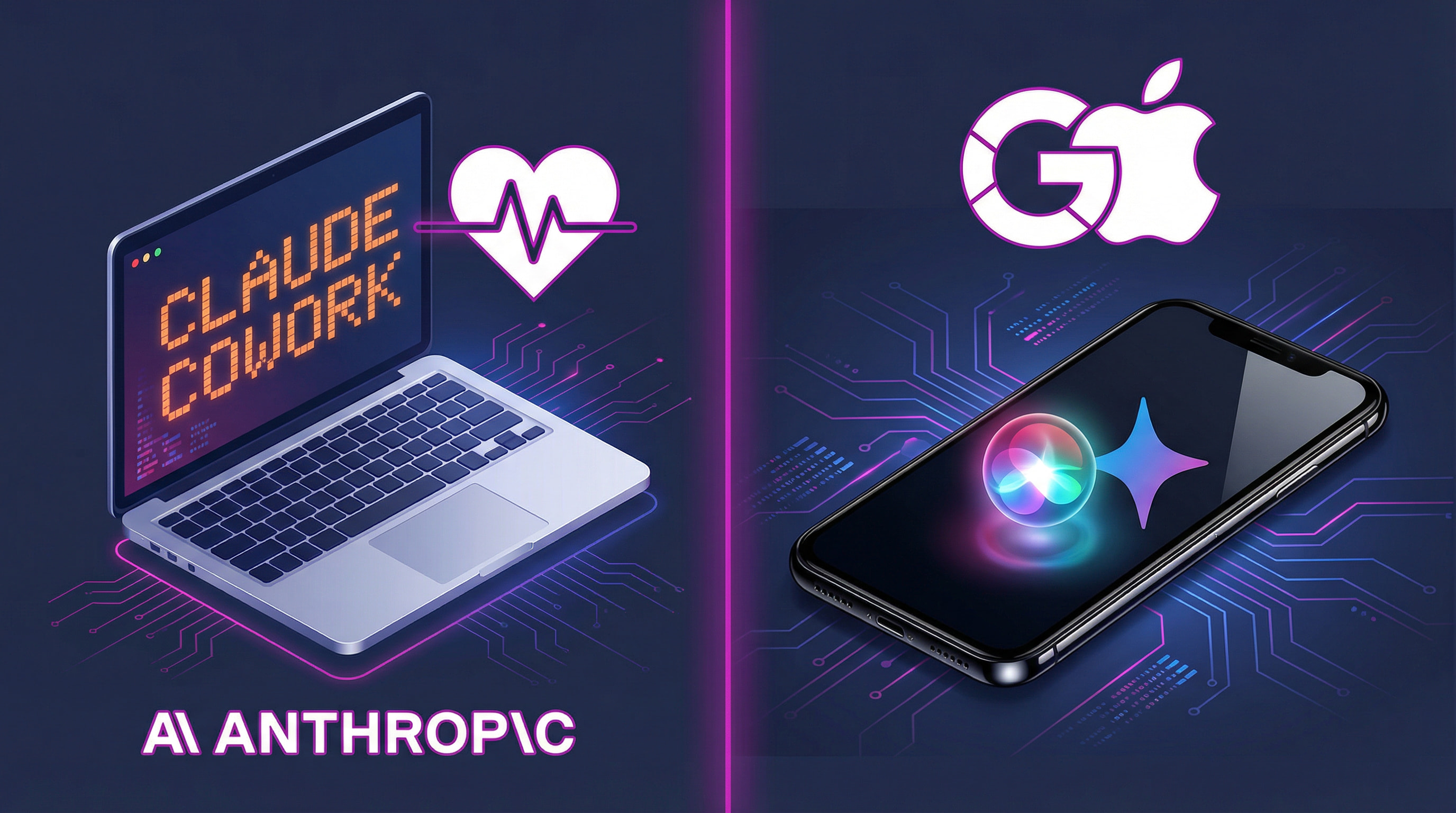
Claude Cowork, Medical AI and the Google-Apple Alliance: 3 News That Redefine the Industry
Anthropic launches Claude Cowork and Claude Health, while Google and Apple close a historic deal. We analyze the three moves shaking up the AI sector.
Yesterday, Monday January 12th, three movements occurred that redefine the Artificial Intelligence sector.
If you work in technology or have a business, you need to understand what Anthropic, Google and Apple just did.
Two products were launched and one agreement was closed that leaves OpenAI in a very delicate position.
Let’s analyze it.
Claude Cowork: The “ChatGPT Moment” for Autonomous Agents
To understand the magnitude of this, we need to look back.
A few weeks ago, Google engineers admitted that “Claude Code” solved in one hour what took them a year to design.
Yesterday, Anthropic used that base technology to launch Cowork.
Forget about “chatting” with AI. With Cowork, you don’t chat, you assign.
It’s an orchestrator. You give it a complex goal and it divides the task, uses other apps, writes the necessary code and supervises itself.
The end of “wrappers”
This kills the business model of thousands of startups.
All those companies that were “wrappers” or intermediaries, connecting one app with another, no longer make sense.
If the base model (Cowork) already knows how to orchestrate and execute workflows from start to finish, you don’t need to pay for extra software.
We’ve moved from AI as a copilot that suggests things, to AI as a coworker that executes the dirty work.
Claude Health: Clinical Specialization (vs OpenAI)
The second launch comes just one week after the OpenAI Health announcement.
And this is very interesting, because the strategy is radically different.
Two opposite approaches
While OpenAI bets on mass consumption with an assistant for you to check symptoms at home, Anthropic went directly to the professional sector.
They understood that to enter critical medicine, the generalist model doesn’t work.
Claude Health is a version of the Opus 4.5 model specifically trained with medical literature and strict regulatory compliance (HIPAA and GDPR).
It’s not for self-diagnosing a headache.
For healthcare professionals
It was launched via API for hospitals and as a “Workstation” for professionals.
It allows a radiologist to upload a CT scan and get a second opinion in 3 seconds with accuracy that yesterday exceeded the human average.
It’s the real and regulated entry of AI into healthcare.
Google and Apple: The Great Alliance
And the final touch. The open secret is confirmed.
Apple, recognizing its delay in generative AI, has opted for pragmatism: “If you can’t beat them, join them”.
Gemini on iOS 20
The deal integrates Gemini natively into iOS 20.
Siri becomes the voice interface, but Google provides the “brain”.
This places Google’s intelligence in a billion pockets overnight.
The big loser: OpenAI
The big loser? OpenAI.
With Microsoft manufacturing its own chips and Apple allying with Google, the creators of ChatGPT are left without a native operating system to live in.
In summary
It seems that Anthropic dominates autonomous work and technical specialization, and Google and Apple dominate mass distribution.
Not bad for an ordinary Monday.
Sources
Which news excites you the most? Let us know on our social media.
Related articles
40 Million People Use ChatGPT Every Day for Health Topics
OpenAI reveals that over 5% of ChatGPT messages are medical queries. Discover how AI is transforming healthcare with surprising data.
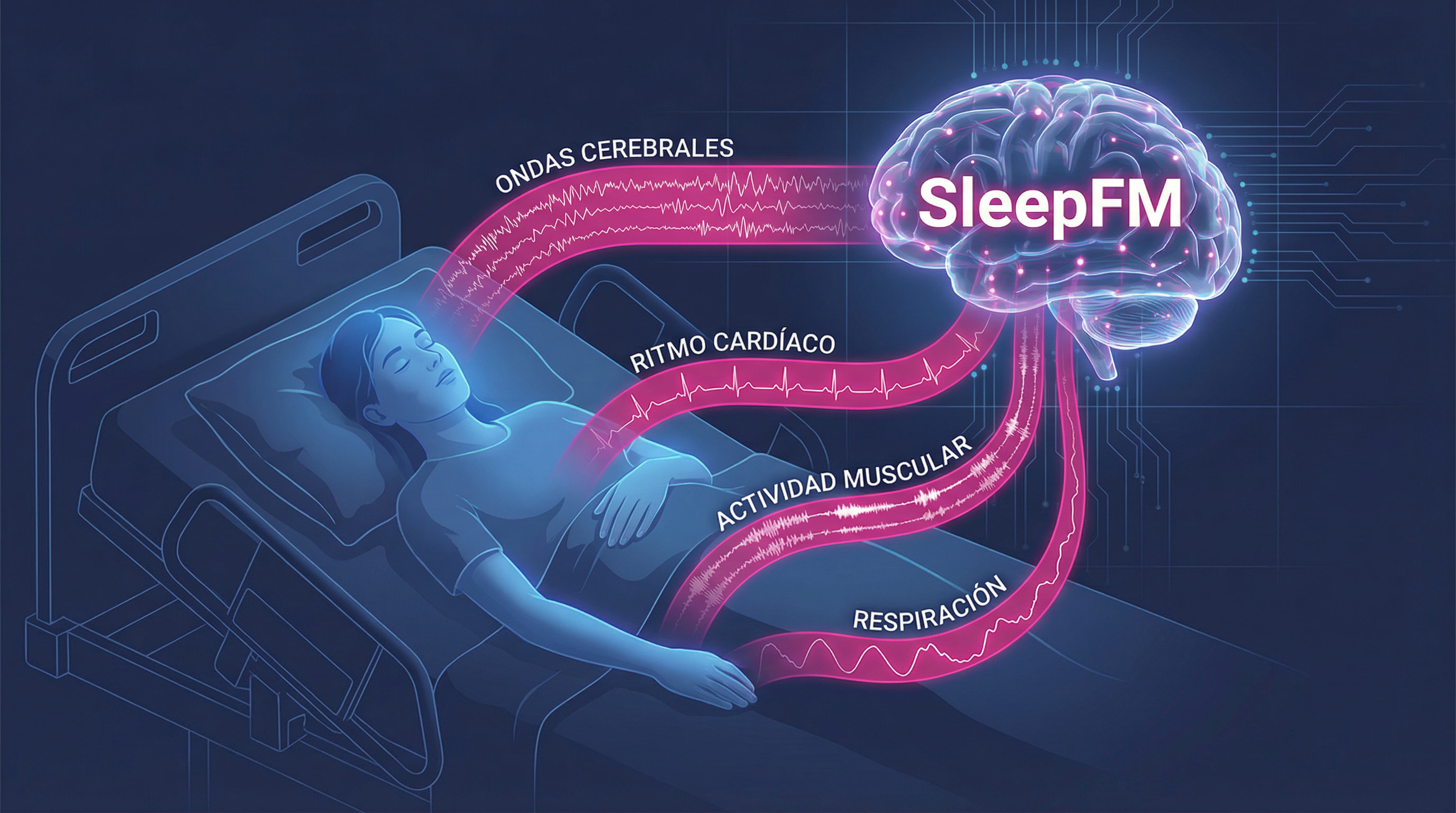
SleepFM: Stanford's AI That Predicts 130 Diseases While You Sleep
An artificial intelligence model analyzes a single night of sleep to predict your risk of dementia, heart attacks, Parkinson's and over 130 diseases.
Psilocybin Rewires the Brain: Scientists Discover How It Breaks Depression Patterns
Cornell scientists map for the first time how a single dose of psilocybin reconnects neurons and breaks negative thought loops in depression.