

13%
of workers apply what they learned in training to their day-to-day work.
Source: Randstad
For companies · Fully bespoke
Transversal, Equipos and Desarrollo: three different scopes, with the content built on your processes and delivered by working professionals. You pick the scope, we fit it to your sector, and your team starts.
The problem
It is not your team’s fault: off-the-shelf training ends in a certificate and a folder nobody opens again. Meanwhile everyone uses AI on their own, with no guidance and no traceability. The sector data backs it up:
13%
of workers apply what they learned in training to their day-to-day work.
Source: Randstad
58%
of companies name the skills gap as the main brake on their AI projects.
Source: Navertia
43%
of professionals use AI at work, against the 93% who say they know the tools.
Source: GAD3 · Planeta
AI Act · Art. 4
Since 2 February 2025, the European AI Regulation requires companies to ensure AI literacy among staff. Handled properly it is not a scare: it is a training plan proportional to each role, with documented records.
The programmes
None of them is a canned course: the content is built for your company, with your sector and your cases in front of us. What changes between the three is who gets trained and how far it goes.

Small and mid-sized companies that want AI to land evenly in every role, without leaving an area out.
What they get: one shared AI foundation for the whole workforce, built on your sector.
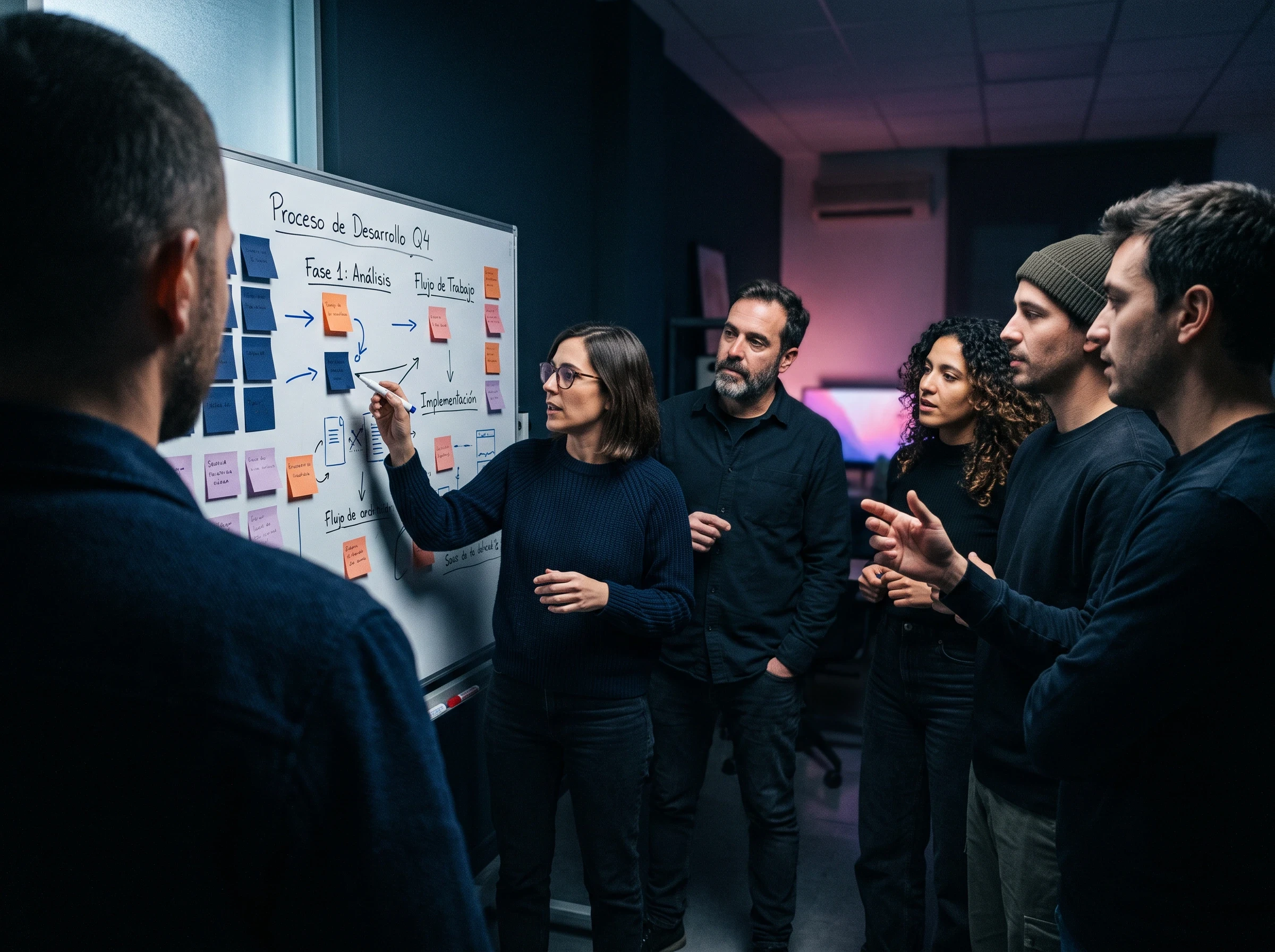
Large companies, or ones with very different teams, where what admin needs is no use to production.
What they get: a different path per team, with each one’s processes in front of them.

Any company that does not want to stop at the training: it ends with a tool of their own, running.
What they get: the training and, behind it, a tool of yours up and running.
The briefing is what decides the programme and the number of days.
Which one is ours?
Four questions and we tell you where we would start.
We would start with
Transversal
The whole workforce at once, speaking the same language.
We confirm it in the briefing, no commitment.
We would start with
Equipos
Each team, working on cases from their own job.
We confirm it in the briefing, no commitment.
We would start with
Desarrollo
The training and, behind it, the software that comes out of it.
We confirm it in the briefing, no commitment.
Answer the four and we will tell you right here.
Not sure which one is yours? Tell us what you need and we will tell you in the briefing.
Coming on your own, not on behalf of a company? These programmes also exist as open courses: Curso de IA desde 0 and Vibe Coding Profesional, with direct enrolment at the academy.
Comparison
Swipe the table to see all three programmes.
| Feature | Transversal | Equipos Recommended | Desarrollo |
|---|---|---|---|
| For whom | SMEs and mid-sized | Companies with distinct teams | Any size |
| Who gets trained | The whole workforce at once | Each team separately | The team that will use the tool |
| Content | General, common to every role | Specialised by team | Training + development |
| Days | 8–12 | 8–12 per team | Split between training and development |
| Indicative duration* | 2–3 months | 3–6 months | Set by the development |
| Bespoke software development | Not included | Not included | Included |
| Price | On proposal | On proposal | On proposal |
* Indicative duration. The exact scope, calendar and price of each programme are closed in the proposal.
How to hire us
What you do, who gets trained, what level they are at and what you want to achieve. This conversation is what decides the content.
Programme, days, calendar, language and format, with the price closed before we start. If it does not fit, you say so and nothing has happened.
Live sessions with the faculty, practice on your own cases, and materials to use the next day.
Or straight to email: hola@aprenderia.es
The faculty
Professionals who use AI daily in their own work, not speakers from a catalogue. Each with their name, their role and their LinkedIn, so you know who will be standing in front of your team.

AI, Drugs & Robots · 280k+
Sets the academic standard behind everything you learn.
LinkedIn
AI Engineer · ex-Santander
Builds the systems he teaches you to build, every single day.
LinkedIn
Ministry of Health · Abu Dhabi
Researches AI in healthcare and teaches on three master’s programmes.
LinkedIn
Digital marketing · AI
Automates lead capture and funnels with AI to scale businesses.
LinkedIn
Cloud Architect & DevOps Engineer
Designs scalable cloud infrastructure and CI/CD pipelines. Works in AWS, Kubernetes and deployment automation.
LinkedIn
AI for digital marketing
Uses AI to optimise campaigns, automate content and read audiences. Turns marketing data into strategies you can act on.
LinkedInFAQ for companies
What people ask us before signing: the substantive doubts first, then the logistics — duration, group size, languages and materials. If yours is not here, write to us.
That is why the programmes are bounded: between 8 and 12 days, in short sessions that work on the team’s real tasks, so the time invested comes back as hours recovered. How many and on what calendar is decided by you before we start.
The risk is already inside: part of your team uses AI on their own, with no guidance and no traceability. The training includes usage criteria — what can be shared with each tool and what cannot — to turn that risk into capability.
Since February 2025, the European AI Regulation requires companies to ensure AI literacy among staff. Training proportional to each team’s role, with a record of who was trained and in what, is the sensible way to cover it: as a plan, not as a panic.
Any of the three programmes can run either way: on site at your offices, or online and live. They are not equivalent — on site concentrates attention and pulls in people who would never sign up on their own; online works better spread over time — so there is no need to choose blind. We sit down with you first: we look at how the team works, what your schedules are and what you expect to get out of it, and the format comes out of that meeting.
Yes, and it is one of the first things we look at. In that first meeting we go through what you actually work with: which tools you have licences for, which ones you are allowed to use and which you are not, and where each team gets stuck. The exercises are built on that — your documents, your processes, your cases — not on textbook examples. What changes between programmes is not how much it adapts, but who gets trained: the whole workforce at once, team by team, or the team that will use the tool we build.
It is counted in days, not loose hours: the range is 8 to 12 and the exact number is closed by you. Transversal spreads them over 2–3 months; Equipos over 3–6, and it is 8–12 for each team trained; in Desarrollo they are split between the training and building the tool.
No strict minimum: we work with teams from 3 people up to whole departments. Size goes into the proposal because it affects format and price, but it does not block anything.
That is decided with you, in the same meeting where the format is settled: not every company wants to take away the same thing. That is where we pin down what comes with each session — the materials the team keeps working with the next day — and whether you want recordings or not. Whatever goes in is written into the proposal before we start, so nobody gets surprises at the end.